2026-07-14 IN THE NEXT BUILD
CALM HANDS. RISING PRESSURE. CARDS EVERYWHERE.
Our draft clock used to tighten by counting laps and, later, by repeatedly multiplying itself. That made a short sprint wait too long for the drama, an endurance race become exhausting halfway through, and a one-lap marathon miss the crescendo entirely. The clock was reading the format instead of reading the race.
Now the leader pulls the whole field through one shared pressure curve. The opening quarter leaves room to read the circuit and the hand. The middle steadily shortens the gap. The final ten percent becomes the card-flinging finish it was always trying to be — whether the flag is one lap away or seven.
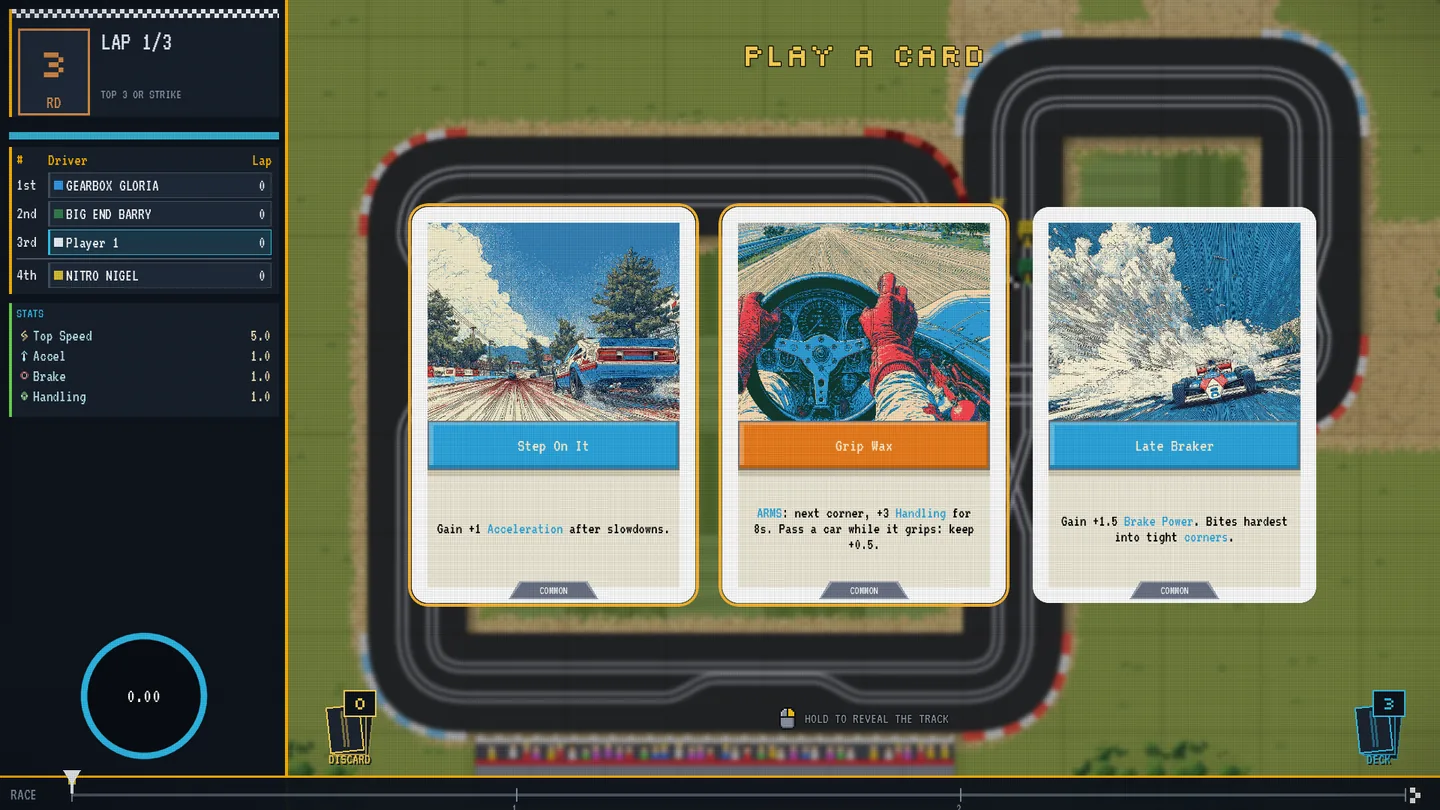
We also repaired the slow-motion itself. A recent loading change let the race spring back to full speed in the tiny gap before the cards appeared. Drafting once again starts at one-fifth speed and settles toward an almost frozen crawl, giving the choice weight without hard-pausing the circuit.
The final interval has a firm six-second floor: urgent, not unreadable. Race length, race type and pit-crew hardware still decide roughly how many opportunities arrive; progress only shapes when the pressure builds. The workshop DRAFT SPIRAL control remains connected for live tuning, but it now strengthens a bounded race curve instead of creating an endless multiplication table.
Small print: card effects, offer size, deck cycling and post-race rewards are unchanged. Nobody has confiscated your right to stare at the middle card until the pit wall panics.