2026-09-03 LIVE IN v0.3.1
RULE ONE: FINISH. THE REST IS DECORATION.
The hardest thing to explain about this game is the thing it is built on: you do not drive the car — the cards do. You can read that sentence and still not believe it, which is why nobody has been reading it. So the first time you ever press PLAY, you no longer go straight to the map. You go to a scrapyard, and a very old man teaches you.
His name is ARMATURE ARTHUR. He was the first car out of the first box, in 1957, back when the whole circuit was one lane of tin and a hopeful bit of string. He set the Kitchen Table 500 record that year with no magnet and a guide braid he cut himself, and he has spent seventy years politely declining to defend it. He teaches instead. He speaks entirely in numbered rules he has never once written down — rule one never changes, every other number drifts, and he will tell you there are nine — and he calls you nipper. His goggles are moulded on. He has not blinked since 1957.
Driver School is not a separate mode and it is not a video. It is a real race on a hand-built scrapyard figure-of-eight, with real cards out of the real deck, the real physics, and Arthur out there in his own oxblood car alongside you. Four times he pulls the race down into slow motion — not a freeze, the same held breath the card draft already gives you — and teaches you one thing. The first hand he deals is a genuinely free choice: three live cards, nothing dimmed, and the only instruction is pick one, because before any stat means anything you have to learn that you do not drive this car — cards do. After that he starts pointing: a hand fans up, the one he means is lit, the other two go quiet; they are still readable, still clickable, and if you reach for one he has something to say about it. Either way, the moment the card lands the screen dims down to the single number it just moved, with an arrow on it.
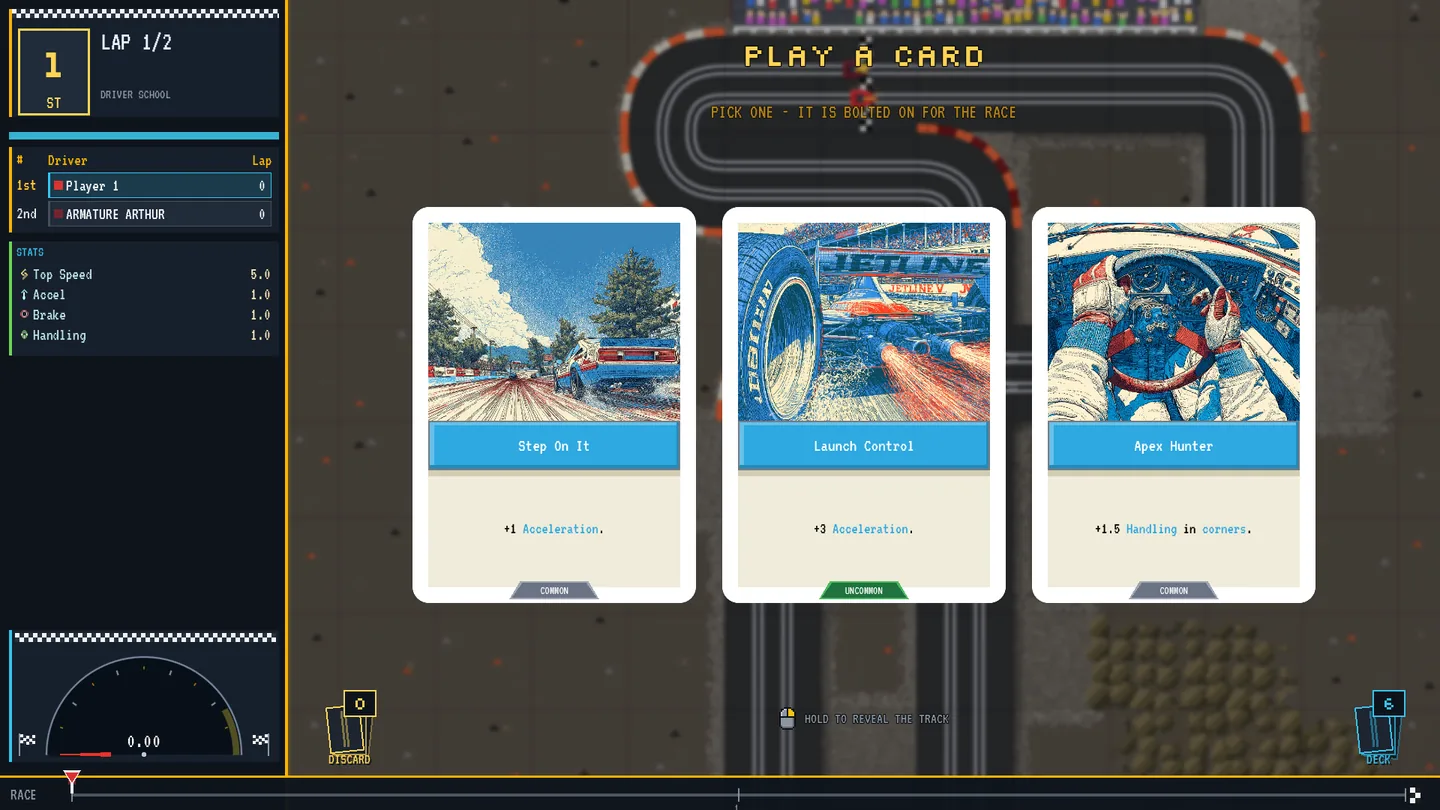
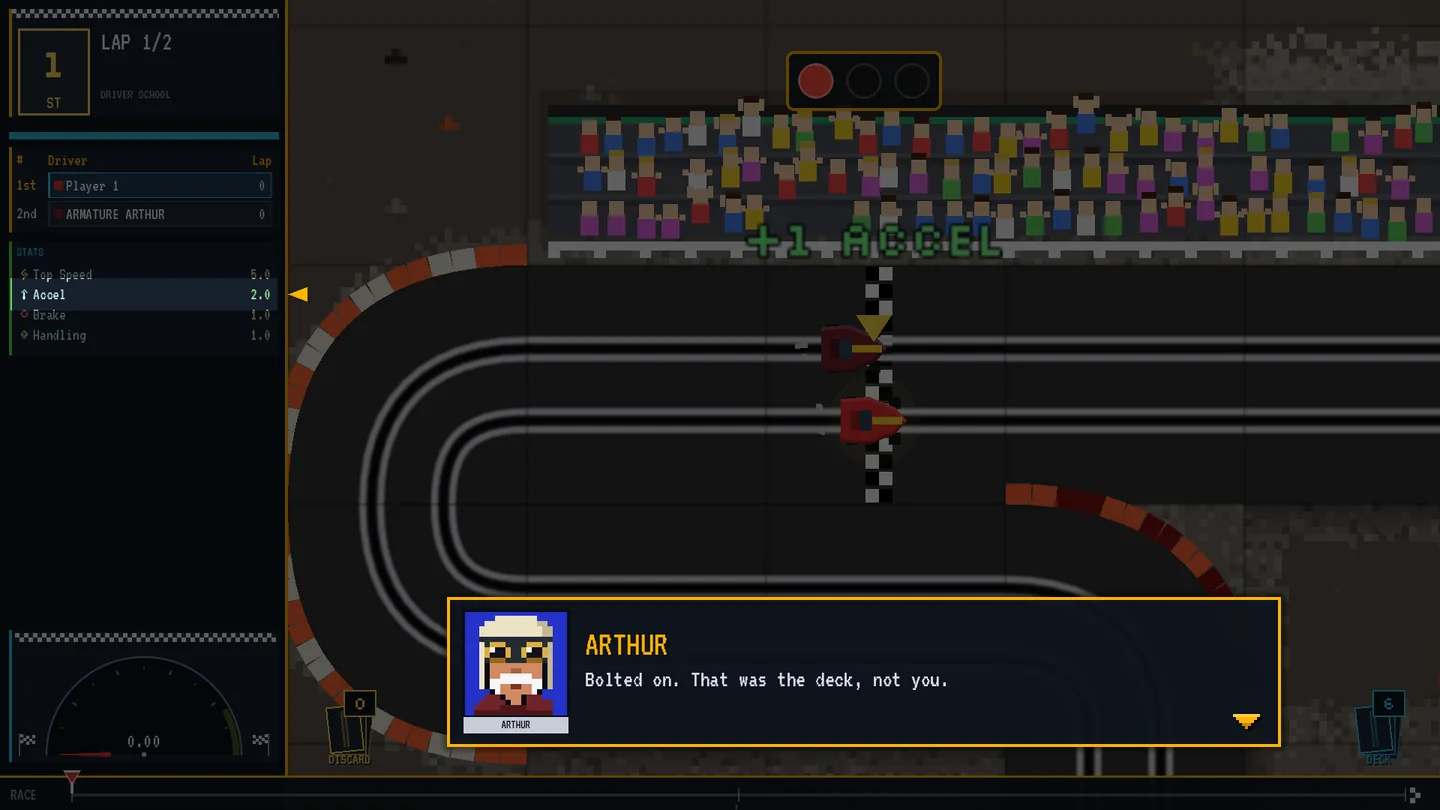
The order is a story rather than a list. You get moving. You find you cannot corner — the first bend arrives four tiles off the line and Arthur simply drives away from you, which is the entire handling lesson and needs no explaining. You fix the corners. Then, on the long straight, he says "come on then. Come past me" — and the top-speed lesson waits for the game to say it first, because nothing here is on a schedule: he only stops you once your wheels have actually started glowing, which is the game telling you there is nothing left in the engine. Then he hands you more of it.
And then he gets you killed. The speed he just gave you is the speed that does it: he tells you to hold it flat through the bend and to trust him, and the car goes off the hairpin in a shower of kerbs — the last corner of a lap you have by then driven four fifths of, so it lands as "I was going too fast" rather than "I never had a chance". While it is still spinning he says: "That one is mine. I said hold it." Then he gives you the number that did it. A corner was a five, you brought six and a half, and that is what brake power is for. Brake is last on purpose: it is the answer to a mistake you have to have made first. It costs you nothing — no strike, no purse, no lost cards. It is the only crash the school will allow you; every other corner in the lesson quietly refuses to bin you.
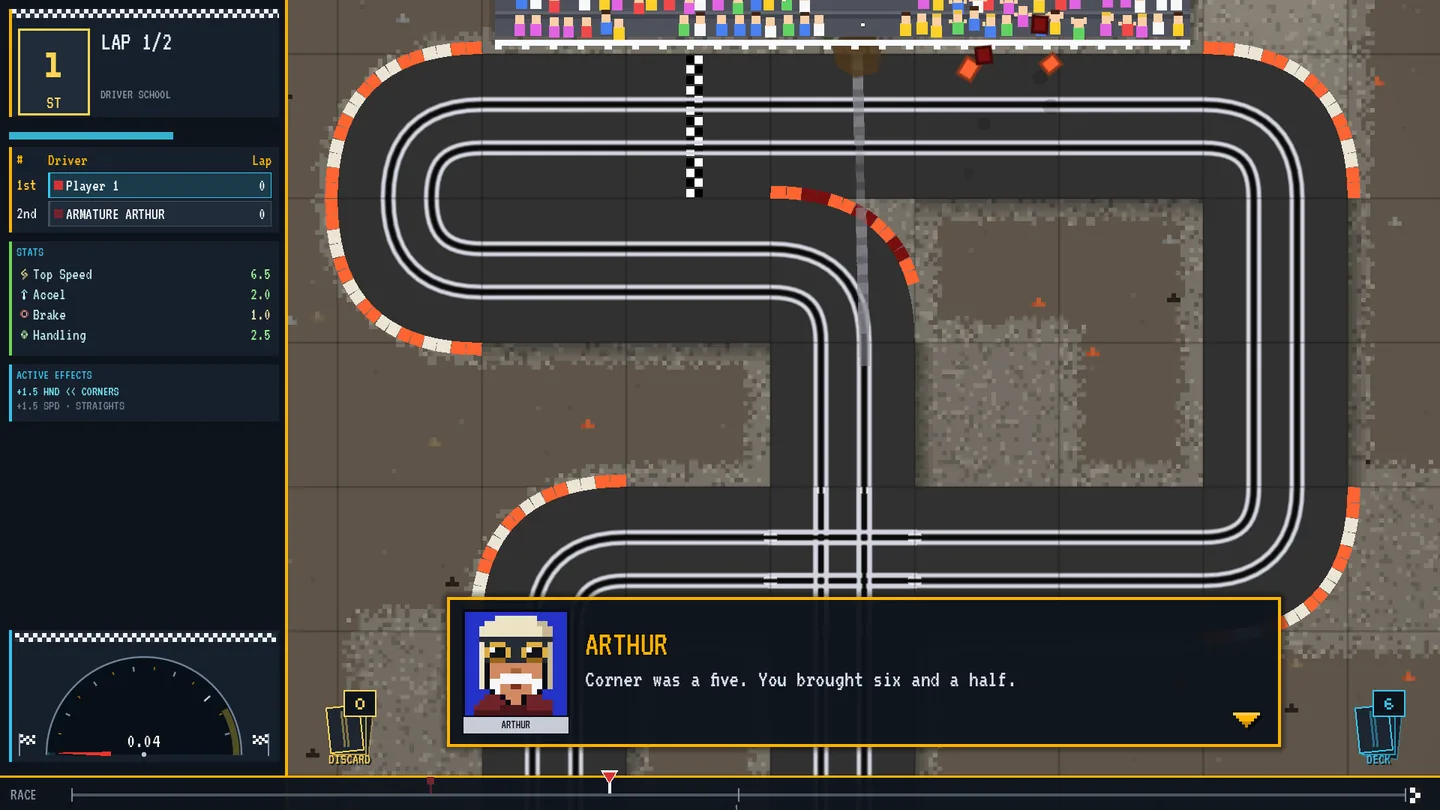
Once all four are in the car he says "the calls are yours now" and stops talking, and you race him properly for the rest of it. Beat him and seventy years of record-keeping quietly ends; lose and he points out that rule one was to finish, and you finished, so what exactly is the problem.
Then the yard connects up to the east. A road flies in bay by bay the same way the circuit assembled itself — and it leaves still looking like the circuit: same asphalt, same slot lines, on solid ground. Then it changes its mind. The deck widens, the slot lines you have been driving in all race funnel inward and turn into a double yellow, a paved stone verge grows out of the edges, the ground runs out at a coastline and pillars come up out of the water underneath. You drive out along a causeway on stilts while the camera settles in behind you — and lands, without you noticing, in exactly the shot the sponsor's signing desk opens on. There is no loading screen. There never was one. That sea was always the road out.
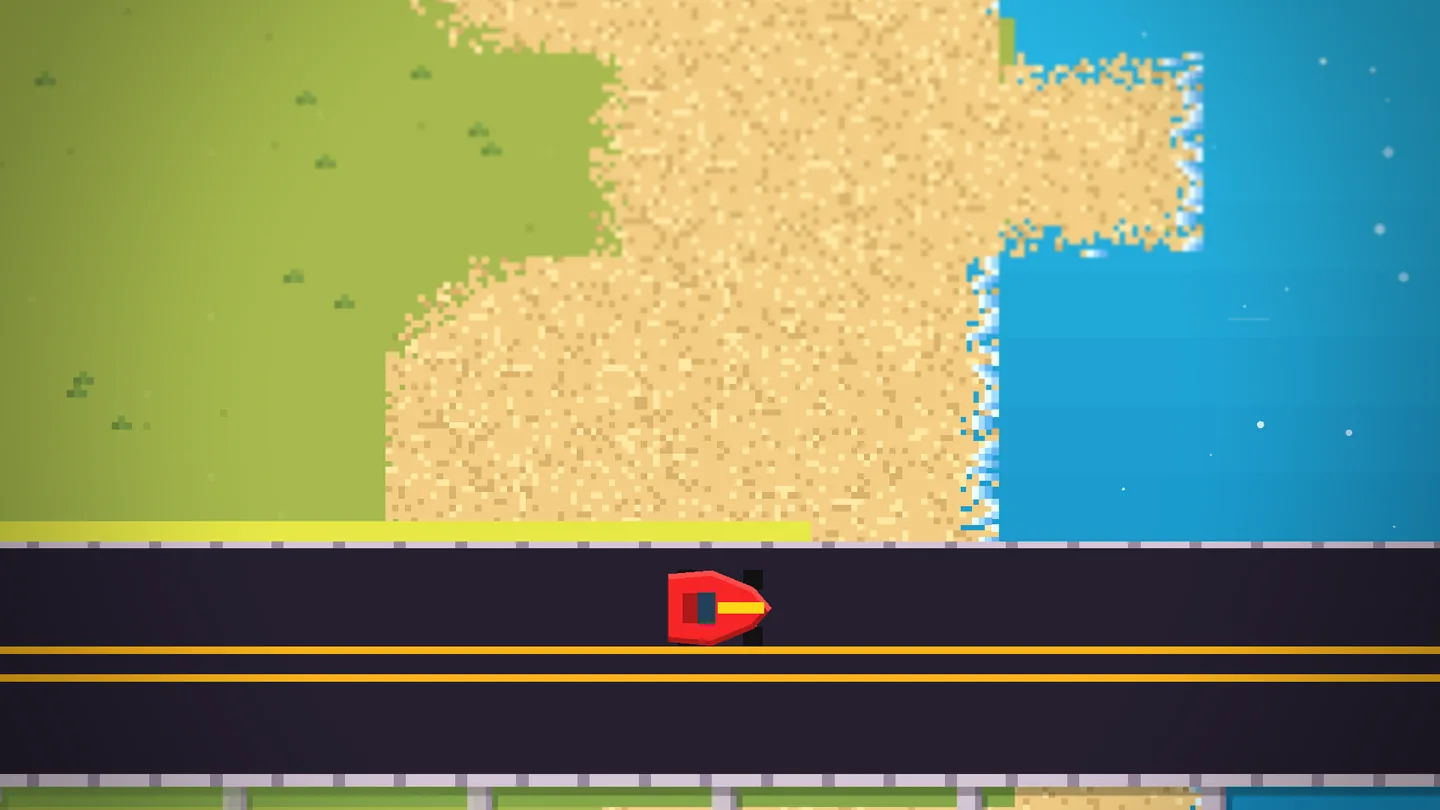
Arthur's parting shot is the one that matters. Rule two, he says, he left blank on purpose. It is yours now.
One more thing, and it is not only for beginners: every stat rise in the game now pops. Cards, hardware, event boons — anything that pushes a number up in the sidebar makes it jump. It was added so Arthur had something to point at, and then it turned out the whole game had been quietly changing those numbers without ever telling you.
Small print: Arthur's box has no buttons on it at all — a bobbing arrow in the same corner every time, and any of A, Space, Enter or a click to read on. Driver School is replayable forever from the new DRIVER SCHOOL row on the main menu, and Arthur has a full file in the Fact File once you have been through it. He is not on the driver roster, so he will never turn up at an ordinary race node. Not yet, anyway.